

New empty liquor bottles should not be cleaned with one universal recipe before filling. Start by keeping the bottles protected, inspecting the received lot, and identifying physical, chemical, and microbiological hazards. The filler should then approve a documented preparation method for the actual bottle, spirit, decoration, and line. Depending on that assessment, the method may be controlled dry feeding, inversion and inspection, validated air or vacuum treatment, a water rinse, or cleaning and disinfection. Do not improvise water temperature, chemicals, pressure, or cycle time: the wrong method can leave residue, retain moisture, damage decoration, or stress the bottle.
This guide covers new, single-use glass and ceramic liquor bottles entering a commercial filling operation. Used consumer bottles and returnable-bottle washing require a different risk assessment and process.
First, separate inspection, cleaning, and disinfection
These words describe different controls. Treating them as interchangeable can create gaps in a filling specification.
- Inspection looks for foreign matter, chips, cracks, finish damage, residue, odor, moisture, or packaging damage. It can reject a bottle, but it does not remove a contaminant.
- Cleaning removes soil, residues, dirt, grease, or other objectionable matter. The Codex General Principles of Food Hygiene uses this distinction and applies controls according to the operation and hazards.
- Disinfection reduces viable microorganisms to a level that does not compromise food safety or suitability. It may follow cleaning when the filler’s hazard analysis says it is necessary.
- Release is the documented decision that the bottle lot and line controls meet the approved criteria for filling. A bottle can look clean and still lack the records needed for release.
New single-use bottles also differ from reusable containers. Codex notes that equipment and containers should be designed for adequate cleaning, while making an exception for containers intended for single use. That does not mean a new bottle can be filled without controls. It means the business must protect the packaging, assess its incoming condition, and choose appropriate preparation instead of assuming a reusable-container wash cycle applies.
Who decides how empty liquor bottles are prepared?
The filler owns the operating decision because its team controls the product, filling environment, equipment, water or air systems, monitoring, corrective actions, and production records. A bottle supplier can agree cleanliness, packing, handling, and documentation requirements, but cannot validate a filling line it does not operate.
| Party | Primary responsibility before filling | Evidence to exchange |
|---|---|---|
| Bottle supplier | Manufacture and pack bottles to the agreed specification; protect openings and interiors during handling and shipment; identify the lot. | Approved bottle drawing, finish details, decoration specification, packing method, lot information, and agreed conformity documents. |
| Brand or packaging buyer | Make the supplier-to-filler handoff explicit and confirm the target market, spirit, closure, decoration, and production route. | Controlled packaging specification, approved sample, responsibility matrix, and change-control contacts. |
| Filler | Assess hazards, approve the preparation method, set line parameters, define acceptance and stop criteria, monitor the run, and release or hold the lot. | Receiving record, approved procedure, line checks, deviations, corrective actions, and release record. |
| Equipment, water, air, or chemical specialist | Confirm compatibility and operating conditions for the exact equipment and treatment medium. | Current manufacturer instructions, suitability information, service records, and validation support where required. |

For projects that are still defining bottle geometry, artwork, and samples, the custom bottle development workflow provides the right place to record these handoff decisions before production.
Choose the preparation method from the risk, not from habit
The correct question is not “Should every bottle be washed?” It is “Which hazards are reasonably possible for this bottle and route, and which validated control will reduce them to the filler’s acceptable level?”
| Possible approach | When it may be considered | What must be confirmed |
|---|---|---|
| Protected dry feed with inspection | New bottles arrive in intact protective packaging and the filler’s approved process accepts them without a wet step. | Incoming condition, handling controls, inspection coverage, reject criteria, and protection up to filling. |
| Inversion plus inspection | The line uses orientation to help identify or remove loose foreign matter before filling. | Equipment capability, inspection effectiveness, bottle stability, and a defined response when material is found. |
| Validated air or vacuum treatment | The filler has equipment intended to remove loose particles from containers. | Equipment instructions, treatment-medium suitability, bottle and decoration compatibility, maintenance, monitoring, and effectiveness. |
| Water rinse | The hazard analysis and line design support a wet rinse. | Water fitness for intended use, bottle compatibility, drainage and drying, residue prevention, monitoring, and what happens after a stoppage. |
| Cleaning and disinfection | A documented hazard assessment requires a stronger control and the full method is approved for the operation. | Correct sequence, approved agents, exact equipment settings, contact conditions, residue control, compatibility, validation, verification, and records. |
International guidance supports this risk-based approach. The Codex framework says control measures essential to food safety should be scientifically validated and then monitored, verified, and documented. For EU food businesses, Regulation (EC) No 852/2004 addresses hygienic packaging operations, suitable water where required, and assurance of container integrity and cleanliness where appropriate. Neither source supplies a universal liquor-bottle rinse setting.
A practical sequence from bottle specification to line release
1. Define the incoming bottle condition
Before ordering, state how bottles will be packed, closed off from dirt, identified by lot, transported, and presented to the line. Link the packaging drawing to the approved finish, closure, and decoration version. If the project uses both glass liquor bottles and ceramic or porcelain liquor bottles, do not assume the same handling and treatment settings suit both.
The specification should also say who decides whether a nonconforming lot is accepted under concession, reworked under an approved method, returned, or rejected. “Visually clean” is too vague unless inspection conditions and defects are defined.
2. Inspect the shipment before moving it into production
Check pallet or carton damage, moisture exposure, broken dividers, open inner protection, incorrect lot identification, and evidence that bottles moved or collided in transit. Select and document an inspection plan appropriate to the risk and the filler’s quality system.
Place the lot on hold and escalate when bottles show chips or cracks, loose glass, visible foreign matter, unexplained residue or odor, retained liquid, widespread scuffing, or a decoration change. Do not try to “wash away” evidence of an unknown problem before the cause and disposition are agreed.
3. Protect bottles between receiving and filling
Store packaging in a clean, dry, controlled area according to the agreed conditions. Keep bottles in protective packing until the approved point of use, manage partially opened cartons, and prevent contact with cleaning chemicals, dust, pests, damaged pallets, or uncontrolled rehandling. A successful receiving inspection loses value if bottles are exposed afterward.
4. Run only the approved preparation step
Use the filler’s current procedure and the relevant equipment instructions. Confirm the bottle format and line recipe before starting. If the preparation uses water, air, vacuum, or a chemical agent, the filler should approve the source, condition, monitoring, and response to deviation. The method must account for what happens to loosened material and how a bottle is protected between treatment and filling.
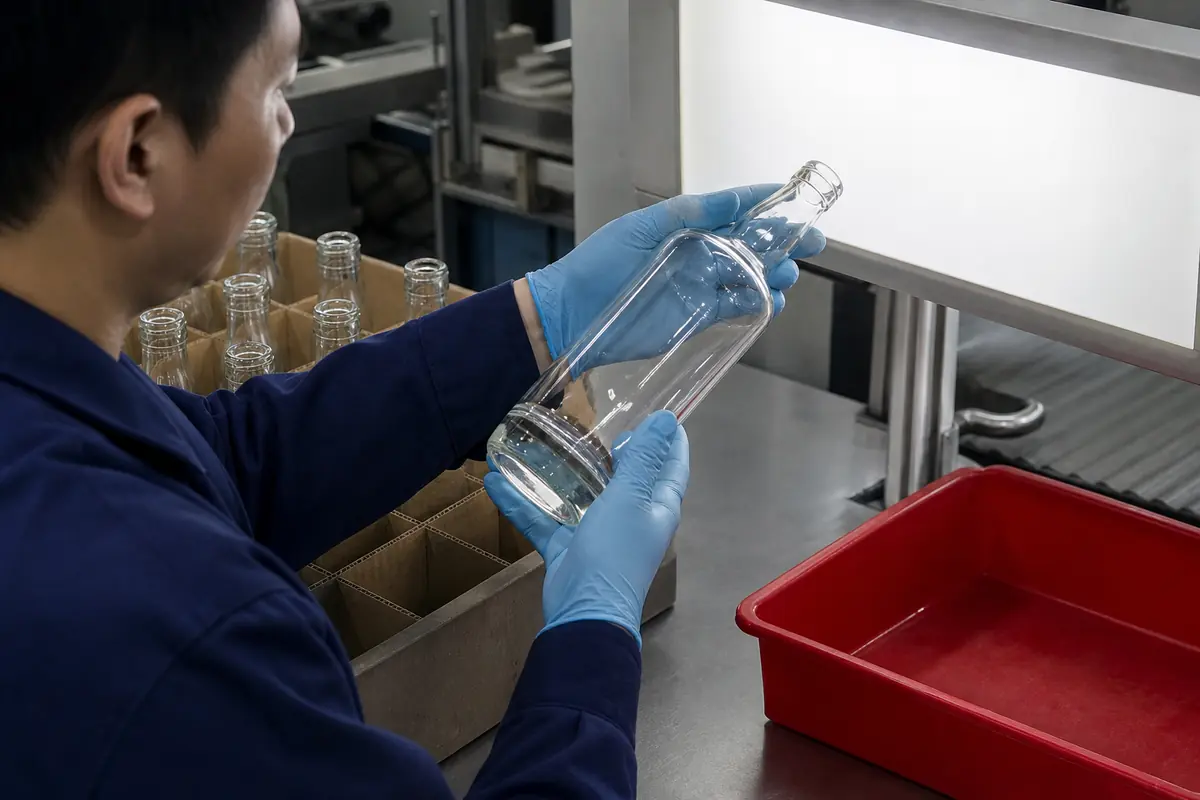
5. Confirm drainage, dryness, and decoration compatibility
A wet process changes the control problem. The team must prevent residual water or treatment chemicals from entering the spirit and must define how drainage or drying is achieved and checked. Do not rely on alcohol in the final product to correct an uncontrolled preparation step.
Decoration adds another interface. Coatings, printing, labels, metallic effects, and adhesives may react differently to moisture, heat, abrasion, or chemicals. Confirm compatibility on the production-representative bottle, not only on undecorated glass. Ceramic and porcelain bottles also need attention to the approved glaze or decoration, opening geometry, handling stability, and any places where moisture could remain. The supplier and filler should review these risks together without substituting assumptions for trials.
6. Verify, release, and retain the record
Before filling proceeds, confirm that the correct bottle lot, preparation method, line setup, and inspection criteria are in use. Record deviations and segregate affected bottles. Release should be made by the responsible filler role under its quality system, not inferred because no obvious dirt is visible.
The OIV wine-industry hazard guide is not a spirits-bottling instruction, but it illustrates a useful control model: supplier control, cleaning and disinfection, water control, physical foreign-body risks, responsibilities, corrective action, verification, and records belong in one connected system.
What changes between glass and ceramic liquor bottles?
The same decision framework applies, but the physical checks may differ. Clear glass can make some internal visual checks easier, while colored, frosted, coated, embossed, or opaque bottles can limit what the operator or camera sees. Ceramic and porcelain bottles are usually opaque, so the filler cannot treat external appearance as proof of the internal condition.
Material is only one variable. Bottle shape, shoulder, base, finish, opening diameter, weight distribution, decoration, and line handling all influence what can be inspected and how the bottle moves through equipment. Coordinate the selected bottle with the closure and bottle-finish specification, because preparation, filling, and closing are consecutive steps rather than separate packaging projects.
Questions to ask the filler before approving production
- Does the procedure cover new single-use bottles, or was it written for returnable containers?
- Which physical, chemical, and microbiological hazards were considered for this spirit and line?
- Will bottles be accepted dry, inverted and inspected, treated with air or vacuum, water-rinsed, or cleaned and disinfected?
- Who approves the equipment settings and the condition of water, air, or treatment agents?
- How are foreign matter, chips, cracks, residue, odor, and retained moisture detected?
- Which checks are possible on clear, colored, frosted, decorated, or opaque bottles?
- Has the method been checked against the production decoration and bottle format?
- What causes the line or lot to be stopped, held, rejected, or reworked?
- Which records identify the bottle lot, preparation run, deviations, and release?
- What change triggers a new review—for example a new bottle, decoration, supplier, closure, line, or treatment medium?
Common shortcuts that create risk
- Assuming every new bottle is ready to fill: protective packing and incoming inspection still need defined acceptance criteria.
- Washing every bottle “just in case”: an unnecessary wet step can introduce water quality, residue, drainage, drying, and decoration risks.
- Using alcohol as the hygiene plan: product alcohol content does not validate bottle preparation or remove physical and chemical hazards.
- Relying only on a light check: inspection is important, but opaque surfaces and process limitations can hide conditions that require other controls.
- Leaving ownership between suppliers: a bottle specification without a filler procedure—or a filler procedure without an incoming specification—creates an uncontrolled handoff.
- Copying settings from another line: equipment, bottles, decorations, products, and regulations differ. Use approved instructions and validation for the real operation.
A concise pre-filling handoff checklist
- Approved bottle drawing, finish, closure, decoration, and production sample match the order.
- Incoming cleanliness, packing, lot identification, transport, and storage requirements are documented.
- The filler has approved the preparation method and stop criteria for this bottle and product.
- Water, air, vacuum, equipment, or treatment-agent controls are defined where used.
- Glass and ceramic visibility, shape, decoration, drainage, and handling limitations have been reviewed.
- Inspection, deviation, segregation, corrective action, and release records identify the lot.
- Supplier, buyer, filler, and technical specialists know who approves each decision and change.
If you are coordinating a new bottle with a contract filler, share the bottle drawing, closure type, decoration method, packing route, and the filler’s preparation requirements before approving the production sample. Review the custom liquor bottle importing checklist for the wider document handoff, or send Shang Art your packaging brief so the bottle and sample discussion can include the filler’s confirmed interface requirements.