
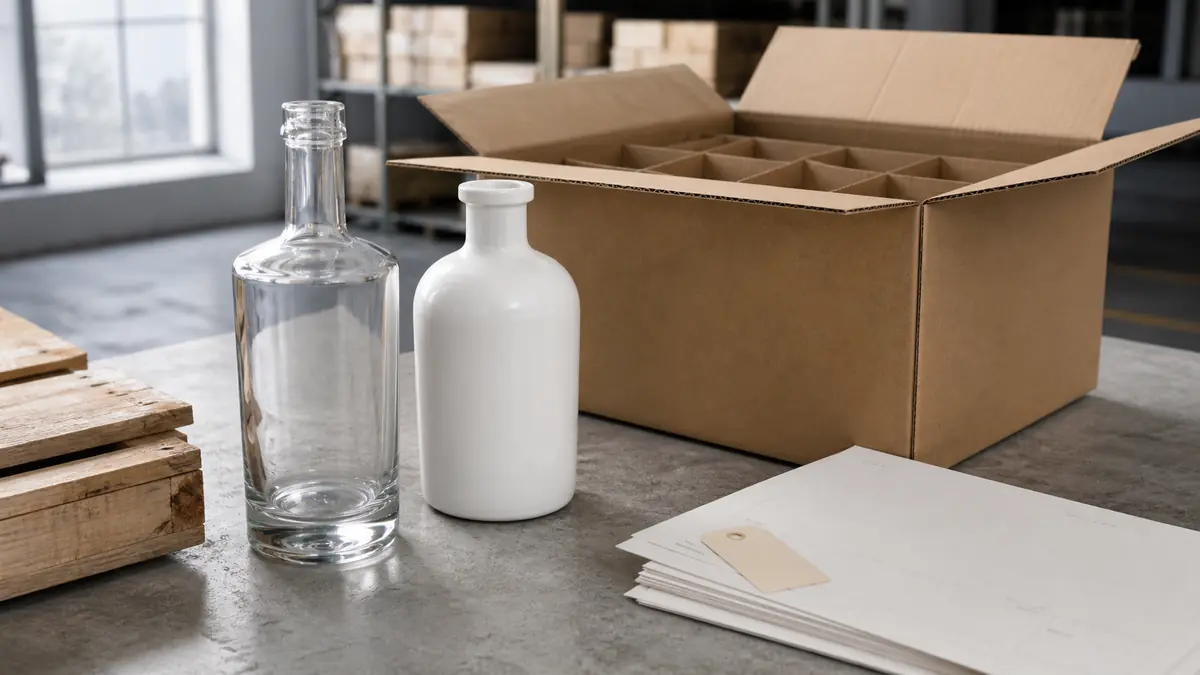
Before importing custom liquor bottles, confirm six things in writing: the destination market, who owns each compliance decision, the complete bottle-and-closure specification, the required food-contact and packaging documents, the tested transport configuration, and the inspection criteria at shipment and receipt. A low unit price is not comparable until those items are fixed. The correct requirements also depend on whether you are importing empty bottles for local filling, decorated empty bottles, bottle-and-closure sets, or finished alcoholic beverages.
This guide is for commercial buyers sourcing empty custom glass or ceramic liquor bottles across borders. It shows how to build a usable project brief and responsibility chain. It does not replace customs, food-contact, alcohol-labeling, tax, or legal advice for a particular country.
First identify what is crossing the border
“Liquor bottle import” can describe very different transactions. Separating them at the beginning prevents packaging documentation from being confused with alcoholic-beverage authorization.
| Import scenario | Packaging questions to settle | Additional responsibility to assign |
|---|---|---|
| Undecorated empty bottles | Material de la botella, capacity, dimensions, neck finish, dimensional tolerances, pallet and carton configuration, cleanliness, and receiving inspection | Importer classification, local filling suitability, closure sourcing, decoración, and destination-market packaging obligations |
| Decorated empty bottles | All bottle requirements plus inks, coatings, etiquetas, adhesives, artwork position, rub resistance, and protected contact areas | Artwork and claim approval, food-contact assessment where relevant, local language or marking space, and decoration acceptance |
| Bottle-and-closure sets | Bottle finish, closure dimensions, liner or stopper materials, application method, retention, leakage evaluation, and component packing | Filler trials, tamper-evidence decision, filled-product compatibility, and line-equipment approval |
| Filled alcoholic beverages | The complete primary and secondary packaging system | Alcohol importer licensing, product and label approval, tax, health warnings, origin statements, customs, and any state or local rules |
Por ejemplo, the U.S. Alcohol and Tobacco Tax and Trade Bureau maintains country and import-export resources for alcoholic beverages. Those requirements concern the beverage and the parties trading it; they should not be treated as a generic approval of an empty bottle. Start the project by naming the importer of record, brand owner, filling site, packaging supplier, closure supplier, inspection party, freight forwarder, and regulatory adviser.
Turn the destination market into a packaging brief
A supplier cannot design one “international” bottle specification that automatically satisfies every market. The buyer should issue a market brief before approving shape, capacity, decoración, or carton artwork.
- destination country and any states, provinces, or retailer programs with separate requirements;
- spirit type, alcohol strength, filling temperature, storage conditions, and expected shelf life;
- whether the shipment contains empty components or a filled product;
- required nominal capacity and the party responsible for legal metrology review;
- languages, mandatory statements, barcode area, lot coding, and importer information;
- consumer channel: retail shelf, hospitality, duty-free, gift pack, e-commerce, or wholesale case;
- route: truck, rail, ocean container, air freight, parcel, or a combination;
- packaging-waste, producer-responsibility, deposit, recycling-label, or material-reporting duties;
- documents and tests required before the supplier may start mass production.
Market rules can change while a project is in development. As one current example, the European Commission states that Regulation (UE) 2025/40 on packaging and packaging waste entered into force on 11 February 2025 y generally applies from 12 August 2026. Buyers placing packaging on the EU market should check the provisions and economic-operator duties that apply on the actual placement date rather than relying on an old supplier checklist.
Lock the complete bottle system, not one component
The commercial sample should represent the system you intend to fill and ship: bottle, cierre, liner or stopper, decoración, label, tamper-evident feature, gift box if used, protective divider, case, and pallet. A neck finish drawing without the selected closure does not establish filled-pack performance.
Record the bottle’s nominal capacity, brimful capacity, maximum dimensions, weight range, base and shoulder geometry, neck finish, critical tolerances, surface treatment, and decoration zones. Then add the closure specification and application method. El GS1 Package and Product Measurement Standard can provide a consistent way to communicate package dimensions, although destination-market measurement law takes precedence.
Label and decoration space should be reviewed against the actual market copy. A NOSOTROS. distilled-spirits labeling, for instance, can require specified information and relationships between label elements; el TTB distilled-spirits labeling hub is the appropriate starting point for the U.S. federal requirements. The bottle supplier can reserve panels and control decoration placement, but the brand owner and its qualified advisers should approve the legal copy.
Shang Art’s custom alcohol bottle process connects bottle selection, structure, decoración, closure coordination, muestreo, and production planning. Buyers can review custom glass liquor bottle options o ceramic liquor bottle options, then build the market-specific specification around the selected route.

Request evidence for the intended use
“Food grade” is not a complete document request. Ask which component, material, supplier, production batch, intended beverage, contact condition, test method, and market the evidence covers. Glass or ceramic bottle bodies, inner coatings, closure liners, synthetic stoppers, printing inks, adhesives, and decorative components may have different evidence paths.
For the European Union, the European Commission explains that food-contact materials placed on the EU market must comply with Regulation (CE) No 1935/2004, with good-manufacturing-practice and material-specific or national measures also relevant. For the United States, the FDA’s food-contact-substances resources show why regulatory status depends on the substance and intended use. Neither reference means that a generic supplier statement approves every decorated bottle-and-closure combination.
A documentary review can include, as applicable:
- a component and material list with supplier and revision identification;
- declarations tied to the destination market and intended use;
- test reports that identify the tested sample, method, fecha, result, and issuing laboratory;
- specifications for inks, coatings, adhesives, liners, stoppers, and other product-contact or near-contact components;
- production-lot traceability and an agreed process for material changes;
- artwork approval and a record of which party approved mandatory claims and symbols.
If a report covers a different color, coating, cierre, or substrate, do not assume it covers the ordered configuration. Ask the responsible specialist whether additional evaluation is needed.
Design transport packaging for the actual route
International delivery must be evaluated at several levels: bottle contact points, divider or insert, case, palletized unit load, freight container, transfers between modes, and final warehouse handling. A carton that protects an undecorated empty bottle may still scuff a coated bottle or compress a premium gift box.
Define the number of bottles per case, bottle orientation, divider material, headspace, carton construction, gross case weight, stacking pattern, pallet dimensions, edge protection, stretch wrap or strapping, moisture exposure, container-loading plan, and maximum storage stack. Keep presentation packaging separate from transport protection unless the combined system has been evaluated for both roles. The article on matching a bottle, gift box, and insert explains that distinction in more detail.
If the shipment uses raw-wood pallets, crates, or dunnage, check whether the route brings them within IPPC ISPM 15 and obtain the appropriate treatment and marking evidence. Processed wood products and certain other items can fall outside the standard’s scope, so material identification matters.
For container loading, the IMO/ILO/UNECE CTU Code is a non-mandatory global code covering cargo transport unit suitability, packing, securing, information flow, and unpacking. It complements rather than replaces bottle-package testing, carrier rules, or law.
Approve samples in stages
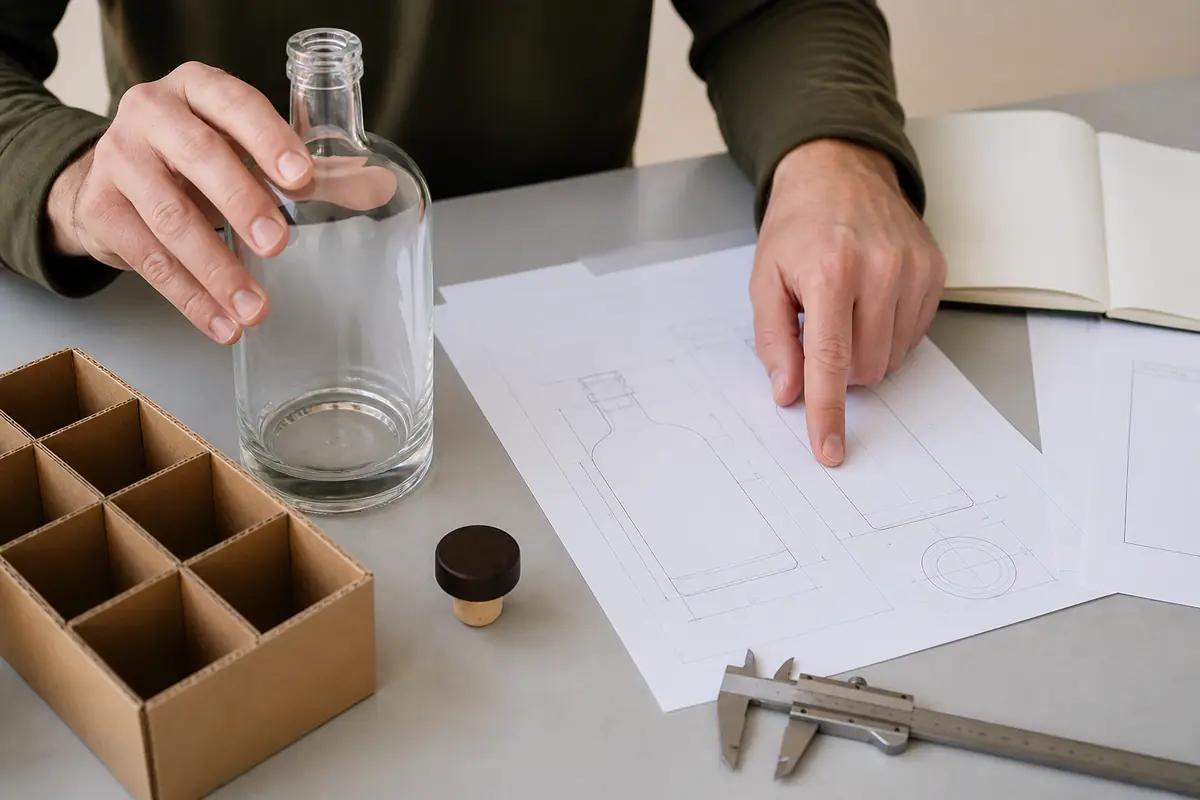
Do not ask one attractive sample to answer every question. Use staged approvals, and record which version passed each gate.
- Specification review: approve the drawing, materials, capacity definitions, critical dimensions, closure interface, decoration zones, and acceptance criteria.
- Bottle and closure samples: check physical fit, application method, removal, reclosure where relevant, and filled-product compatibility through the responsible filler or laboratory.
- Decorated samples: approve color, registration, adhesion or rub evaluation, label fit, protected contact zones, and appearance under intended lighting.
- Packing prototype: pack the actual bottle configuration in the proposed divider, case, gift box, and pallet pattern.
- Distribution evaluation: select a test objective that represents the route. ISTA explains that its procedures range from screening tests to general or enhanced simulations; the correct procedure depends on the desired outcome and distribution environment.
- Pre-production or production reference: retain signed drawings, obra de arte, component specifications, packing instructions, and approved physical samples.
A test record should identify the bottle, cierre, decoración, inner pack, case, pallet, load, sample quantity, conditioning, procedure, deviations, and acceptance criteria. “Export packing” or “drop tested” without that context is not enough to reproduce a result.
Agree the commercial and document handoff
Before the purchase order, state which party provides and approves each document. The exact set depends on the goods, destination, route, and contract, but the handoff may cover:
- commercial invoice, packing list, and agreed product description;
- customs classification responsibility and origin documentation;
- purchase specification, drawings, artwork files, and revision control;
- food-contact and material documents required by the buyer’s review;
- inspection report, quantity record, and approved defect classification;
- packing specification, case and pallet counts, dimensions, and gross/net weights;
- wood-packaging evidence where applicable;
- transport documents, insurance responsibility, agreed Incoterm, and damage-claim process.
The supplier should not select the importer’s customs code, make the final legal conclusion for the destination, or approve the brand’s alcohol label by default. Conversely, the buyer should not expect a freight forwarder to correct an unapproved bottle specification or missing product evidence after the goods are packed.
Define pre-shipment and receiving acceptance
Inspection criteria should be agreed before production, not negotiated after arrival. Separate safety or functional defects from appearance variation, define the sampling method, and use the approved drawing and physical reference. Checks may include quantity, identity, dimensions, capacity method, visible glass or ceramic defects, decoración, closure components, carton condition, pallet markings, and document completeness.
At receipt, photograph the unopened container or load condition, seal where used, pallets, case labels, and any visible damage before unloading. Record affected pallet and case numbers, isolate damaged product, and follow the agreed notification and claim process. Receiving inspection does not replace the supplier’s production controls; it verifies that the delivered shipment matches the commercial record and reveals transport-related issues.
What should you send for an international bottle review?
Provide the destination country, whether the bottles will be imported empty or filled, spirit type, target capacity, bottle material, closure preference, decoration and label concept, cantidad, filling location, distribution channel, transport route, required documents, and target timeline. If available, include the filling-line constraints, pallet standard, retailer requirements, and your regulatory adviser’s document list.
El custom liquor bottle quote-preparation guide can help organize the product decisions. For a project-specific review, contact Shang Art with the market brief and reference files. The team can then identify the bottle, cierre, decoración, muestreo, and packing details that must be confirmed before quotation and production, while your importer and qualified advisers retain responsibility for destination-market approval.