

Choose a square glass liquor bottle when flat display panels, a defined front face, and an architectural silhouette are central to the brand. Choose a round bottle when a continuous surface, wrap-around decoration, and less orientation-dependent handling better fit the project. Neither shape is automatically stronger, cheaper, lighter, easier to fill, or more efficient to ship.
The decision should be made with the actual dimensions, label system, closure, filling line, divider layout, and distribution route. A square outline can appear space-efficient on a drawing, while a round bottle can look easier to handle, but only a physical pack-out and production review can confirm either assumption.
Square vs. round liquor bottles at a glance
| Decision factor | Square or rectangular bottle | Round bottle |
|---|---|---|
| Brand silhouette | Architectural, directional, and strongly front-facing | Continuous, balanced, and visible from many angles |
| Primary label route | Separate front, back, or side panels | Front/back labels or continuous wrap-around decoration |
| Orientation | Often needs a defined front during labeling, packing, and display | May be less direction-dependent unless artwork requires registration |
| Grip | Edges and panels can provide reference points; corner radius matters | Continuous body can feel smooth; diameter and texture matter |
| Carton planning | Appears grid-friendly, but corners, dividers, and orientation require clearance | Requires verified spacing around the diameter and divider contact points |
| Decoration | Clear face hierarchy and panel-by-panel artwork | Strong continuity for wrap-around labels, printing, patterns, or coating |
| Main approval risk | Panel flatness, corners, line contact, and orientation consistency | Label skew, rotation, curved-surface appearance, and uncontrolled artwork position |
These are design starting points, not universal performance guarantees. Softly rounded squares, ovals, flasks, and faceted bottles sit between the two categories and may combine advantages or introduce new constraints.
How shape changes shelf presentation
A square bottle establishes a clear front, back, and sides. That helps a brand create a strong hero panel and organize supporting information on separate faces. The corners also remain visible when the bottle is viewed at an angle, giving the silhouette more structure.
A round bottle has no natural front until the label, embossing, or closure creates one. Its outline remains consistent from different viewing angles, which can support a simple bottle family or a label designed to flow around the body. It can also keep the liquid and reflections visually active as the bottle is turned.
Do not judge either shape only from a front rendering. Place both filled samples at shelf distance, rotate them, and compare how the shoulder, label, base, closure, and neighboring packs affect recognition.
Which shape provides the better label area?
Square glass liquor bottles can offer flat-looking front and rear panels, but the usable label area is smaller than the maximum bottle width. Corner radii, shoulder transitions, base curves, embossing, and normal dimensional variation all reduce the safe application zone. A label that extends too close to a corner may bridge, lift, wrinkle, or appear misaligned.
Round bottles support front-and-back labels, pressure-sensitive labels, wrap-around formats, direct printing, and other continuous decoration. Curvature changes the apparent width of artwork and can make fine text near the edges harder to view from the front. Wrap-around application must control spiral misalignment and the relationship between the leading and trailing edges.
For either shape, test the actual label stock, adhesive, opacity, application speed, filled-bottle appearance, and any wet or cold conditions expected during the project. The choice should follow the label method rather than assuming that a flat panel is always easier.
How do square and round bottles behave on a filling line?
Round bodies can travel without a visually fixed orientation when the process does not require registered artwork. Square bottles are more directional and may need controlled orientation for labeling, inspection, case packing, or display. However, a carefully engineered shaped bottle can still be designed for efficient handling.
In a real shaped-bottle case, Ardagh describes adapting a triangular spirits bottle with contoured edges and defined contact points so it could work on production and filling lines. The useful lesson is not that every angular bottle behaves like a round one; it is that contact surfaces, radii, stability, and the line must be developed together.
Ask the filler or equipment partner to review conveyor guides, accumulation, change parts, rinsing or cleaning equipment, filling heads, capping or corking, label orientation, camera inspection, grippers, and case packing. A bottle that stands correctly on a desk may still rotate, jam, scuff, or contact a guide differently at production speed.
Does a square bottle use carton space more efficiently?
Not necessarily. A square cross-section can fit a visual grid, but the shipping result depends on maximum width and depth, corner radius, divider thickness, protective clearance, orientation, bottle weight, neck and closure height, and the selected case count. Decorative corners or protruding relief may require more space than the nominal body dimensions suggest.
Round bottles also require separation and verified clearance. Depending on the pack, circular bodies may contact dividers at predictable points, but they still need protection from bottle-to-bottle impact, top load, vibration, and drops. The case and bottle must be tested as one packaged product.
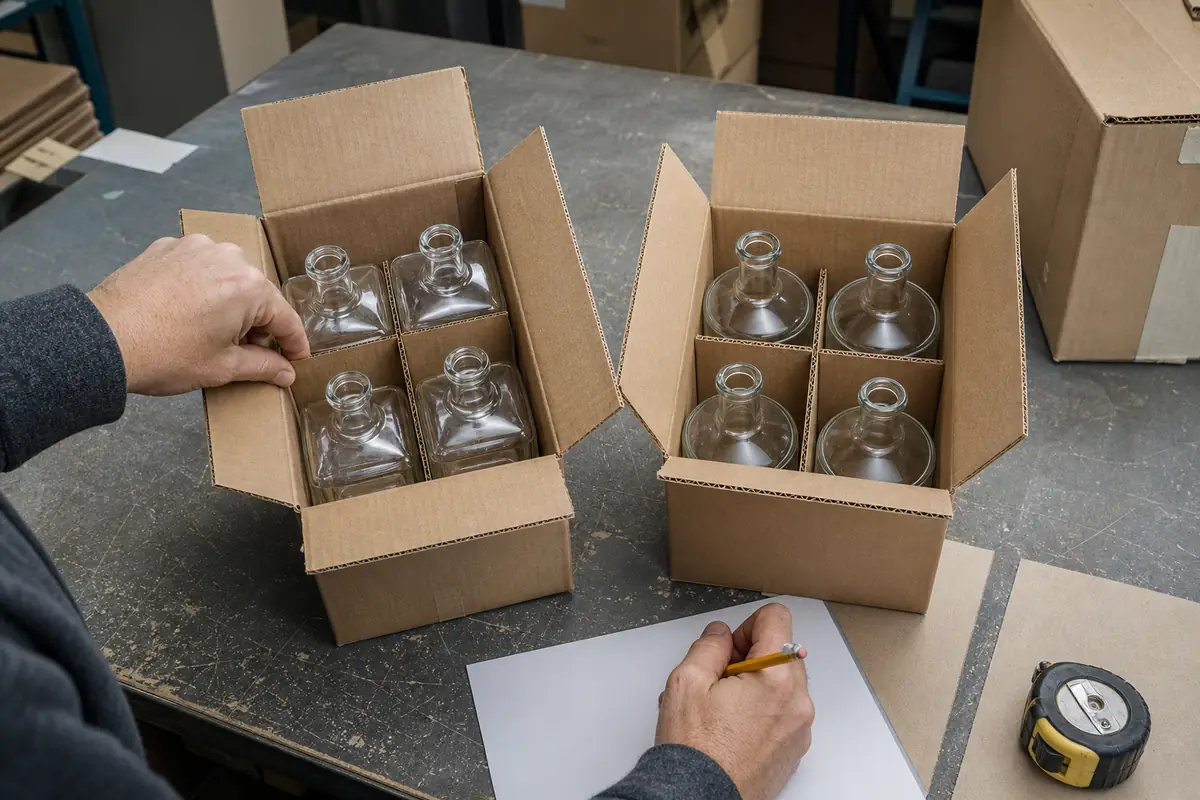
Build trial cases for both options using production-representative bottles, closures, labels, dividers, and cartons. Record outside case dimensions, gross weight, bottle orientation, clearances, contact marks, and damage after the agreed distribution tests. Pallet or parcel efficiency should be calculated from the approved pack, not from a bottle-only drawing.
Grip, pouring, and back-bar use
A square bottle can provide tactile orientation through its panels and edges. If the body is broad, however, the user may grip a corner rather than a face. The corner radius, body width, fill weight, surface texture, and label all influence comfort.
A round bottle offers a continuous grip, but a large smooth diameter can still be difficult to hold. Waist shaping, embossing, fluting, coating, and label texture may improve control. Pouring behavior also depends on the neck, closure, liquid flow, total filled weight, and balance—not simply the body cross-section.
Test with the intended capacity and fill. Observe lifting from a shelf, opening, one-handed and two-handed pouring, resealing, and return to the bar or table. Include the gift box or carton insert if it changes how the bottle is removed.
Manufacturing and glass distribution
Square bottles introduce panels, corners, and transitions that must be designed with suitable radii and glass distribution. Round bottles have a continuous circumference, but their shoulders, base, embossing, and weight can still create complex forming requirements. Shape alone does not establish strength.
The bottle manufacturer should review the complete geometry, including wall distribution, corners, shoulder, heel, base, punt, seam location, embossing, and neck finish. A physical sample then needs the dimensional, visual, internal-pressure or other project-specific tests required by the producer, filler, market, and distribution route.
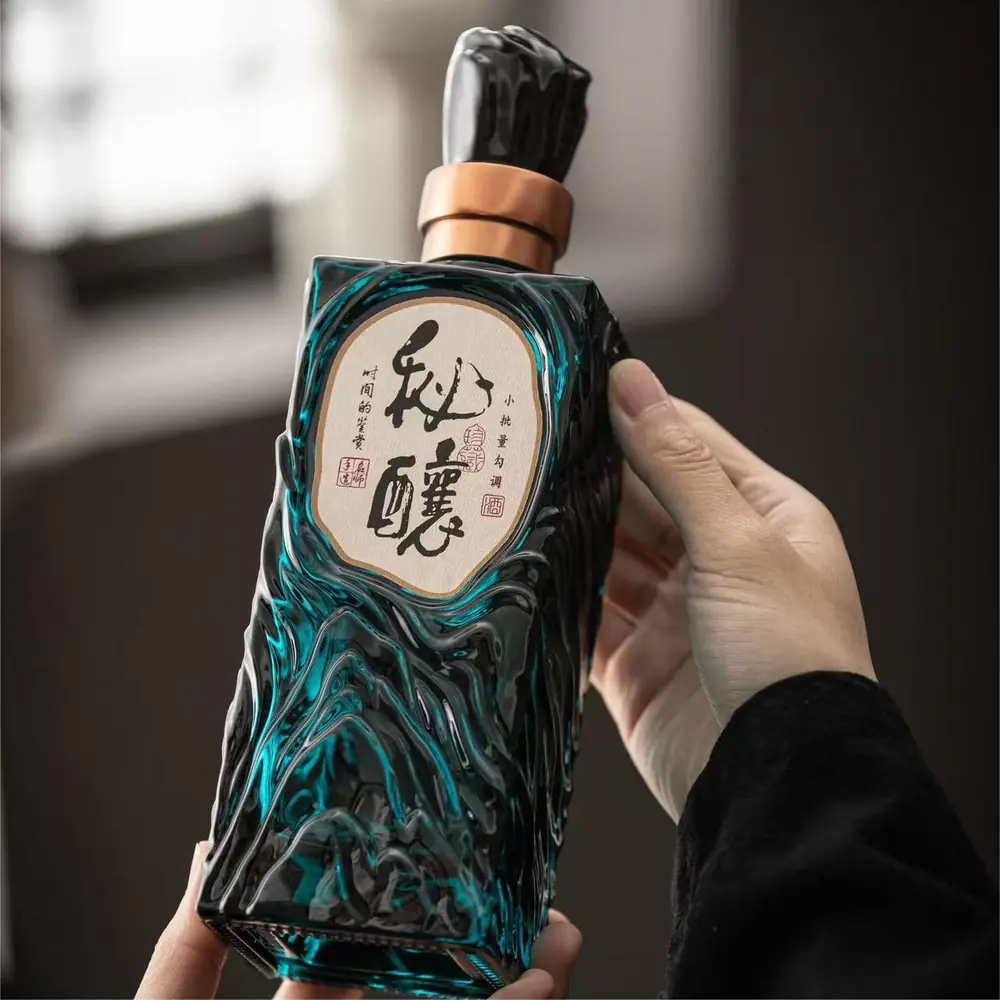
Shang Art’s G17 square transparent bottle shows a relatively restrained flat-panel direction, while the G21 sculpted square bottle demonstrates how a more expressive surface changes the front panel and grip.
Which shape is more sustainable?
Shape alone is not enough to answer that question. Compare the actual glass weight, recycled-content specification, manufacturing route, defect and breakage performance, labels and closures, case materials, bottles per case, cases per pallet, transport distance, and end-market recovery system.
A lighter round bottle may outperform a heavy square bottle in one system; a well-engineered square package may improve pack-out in another. Avoid environmental claims until they are supported by project data using the approved bottle and complete packaging configuration.
A practical square-versus-round sample test
- Keep the comparison fair: use the same nominal capacity, liquid simulation, closure class, artwork area, and target market.
- Record maximum dimensions: measure overall height, width, depth or diameter, closure, protrusions, and gross filled weight.
- Review all viewing angles: compare the front, side, rear, corner, and rotating appearance.
- Apply real decoration: test label stock, direct print, embossing, coating, and registration on each body.
- Check line handling: confirm contact points, orientation, accumulation, filling, closure application, inspection, and case packing.
- Test human use: evaluate grip, opening, pouring, resealing, and removal from secondary packaging.
- Build the shipping case: verify dividers, clearances, top protection, gross weight, case dimensions, and pallet pattern.
- Run relevant tests: agree on vibration, shock, compression, drop, temperature, and other conditions for the intended route.
- Retain the approved system: keep the signed bottle, drawings, labels, closure, case, and acceptance criteria together.
Final recommendation
Choose square when the package needs a defined front, flat-panel hierarchy, and architectural shelf presence. Choose round when continuous decoration, viewing from many angles, and less directional handling better support the brand and line. If the answer is unclear, compare both as filled and packed physical samples with the same artwork and closure.
Shape comparisons should use recorded maximum dimensions rather than nominal outlines. The GS1 Package and Product Measurement Standard defines a repeatable method for measuring product and case height, width, depth, and gross weight.
Review Shang Art’s glass bottle range and production-ready bottle design guide, then use the custom bottle process to organize the preferred capacity, quantity, target market, shape, dimensions, artwork, closure, filling route, and carton requirements. Send the project details through the inquiry page to compare suitable square and round starting options before commercial terms are confirmed.