
Good alcohol bottle design ideas do more than create an attractive silhouette. A successful concept must express the brand, suit the spirit, accept a dependable closure, provide space for decoration and required information, run through production, and survive packing and transport. The best starting point is therefore not a dramatic sketch. It is a clear set of commercial and technical decisions.
This guide shows how to move from a brand brief to a bottle concept that a manufacturer can evaluate, sample, and prepare for production.
Start with the buying situation, not the bottle shape
Before choosing curves, 颜色, or embossing, define where the bottle will compete and how it will be used. A bottle designed for a luxury gift set faces different constraints from one intended for a busy bar, a travel-retail shelf, or an e-commerce shipment.
A useful brief answers five questions:
- Who is the buyer? Define the intended consumer and price position without relying on vague terms such as “premium.”
- Where will the bottle be sold? Note the target countries, retail channels, shelf environment, and whether the package will be sold individually or in a gift box.
- What must the bottle communicate? Identify two or three recognizable brand cues, such as heritage, precision, craft, celebration, or contemporary simplicity.
- How will it be filled and closed? Record the target volume, spirit type, filling method, 关闭偏好, and any existing production-line limitations.
- What is fixed? State the launch window, estimated quantity, target packaging budget, carton requirements, and any artwork or brand elements that cannot change.
These answers create boundaries for creative work. They also make it easier to compare concepts on the same basis instead of choosing the most impressive rendering.
Use six filters to evaluate liquor bottle design ideas
1. Recognition
A bottle should remain recognizable from several viewing conditions: front-facing on a shelf, seen from an angle, held in the hand, or shown as a small online thumbnail. Recognition may come from the shoulder profile, the relationship between body and base, a distinctive ceramic form, controlled embossing, or a consistent closure shape.
Do not ask every feature to compete for attention. One strong structural cue supported by a restrained decoration system is usually clearer than a bottle combining an unusual silhouette, deep texture, multiple colors, a complex closure, and several metallic effects.
2. Material fit
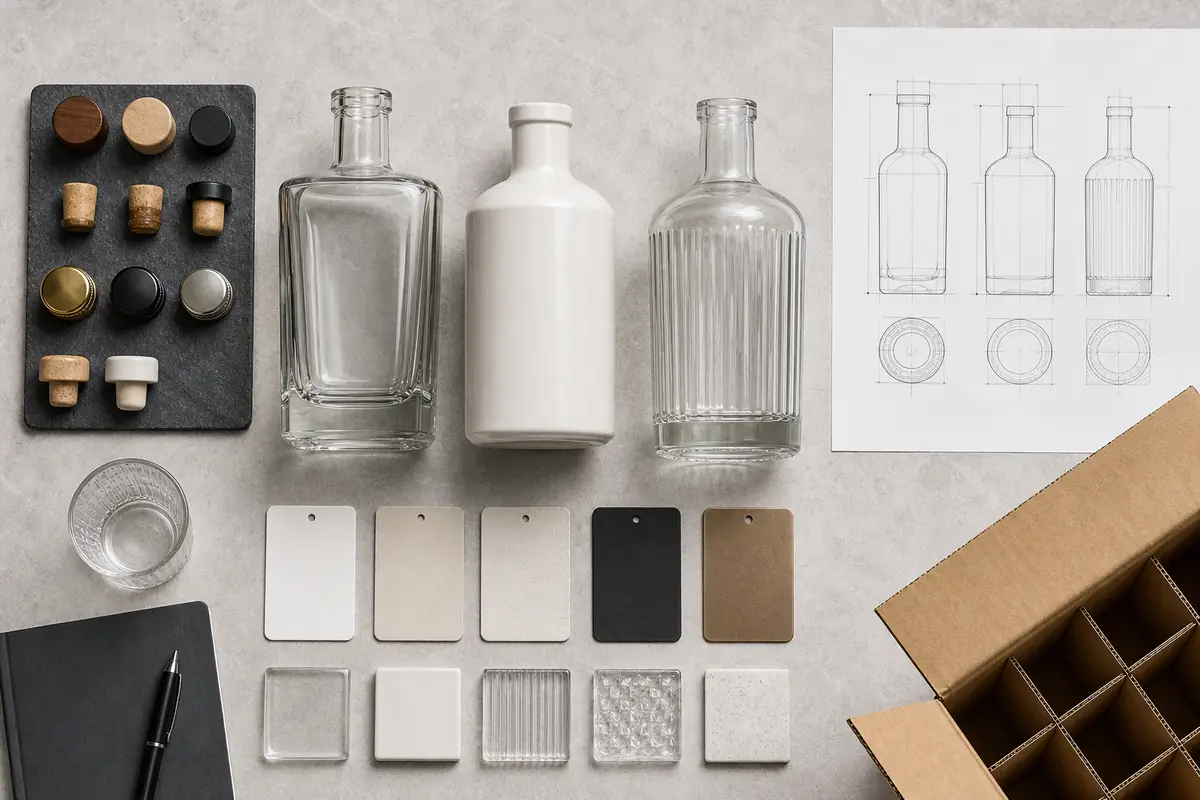
Material changes both appearance and design freedom. Clear or colored glass can reveal the liquid and use transparency, reflections, 压花, coating, 糖霜, and printed decoration. Browse Shang Art’s glass bottle options to see how body, shoulder, base, and surface treatments can vary.
Ceramic or porcelain provides an opaque canvas with a different tactile and cultural character. Glaze, relief, painted details, and sculptural forms can be especially useful when the package should feel ceremonial, collectible, or gift-oriented. The ceramic and porcelain bottle range offers a useful reference for this direction.
The choice should follow the brand experience, filling requirements, decoration plan, and transport needs. It should not be made from appearance alone.
3. Closure system
The bottle neck and closure form one system. A beautiful stopper is not useful if the neck finish, sealing component, 开业经历, and production method have not been considered together. Decide whether the project needs a cork-style closure, screw system, tamper-evident feature, decorative overcap, or another structure, then confirm the relevant tolerances with the bottle and closure suppliers.
Compare the visual and functional options on the bottle caps page, but treat the final selection as an engineering decision. The closure should be tested on the intended bottle rather than approved from separate samples.
4. Decoration area
Every concept needs a realistic plan for labels, printing, coating, 烫金, 压花, or other surface work. Curvature, seams, recessed panels, shoulder transitions, and texture can reduce the usable area or make artwork harder to align. A design that looks clean as an undecorated rendering may become crowded once the brand name, spirit designation, alcohol content, net contents, origin information, and market-specific statements are added.
For products entering the United States, 这 TTB distilled spirits labeling guidance identifies mandatory label information and approval resources. Other markets have their own requirements. Review the destination rules before locking the label panel, artwork hierarchy, or distinctive bottle form.
5. Production compatibility
A concept must be translated into controlled dimensions and manufacturing tolerances. Areas requiring early review include bottle stability, base geometry, glass distribution or ceramic wall design, 颈部饰面, closure fit, decoration registration, contact points on the filling line, and the ability to inspect the finished package consistently.
Ask the manufacturer which features carry the greatest tooling or production risk. A small change to a corner radius, relief depth, shoulder transition, or decoration position can preserve the original design intent while making the package more practical to manufacture.
6. Packing and logistics
The bottle’s true commercial footprint includes its protective insert, dividers, carton, pallet pattern, and any gift box. A wide shoulder or projecting decorative feature may reduce the number of bottles per carton. A heavy base may strengthen the luxury impression but also affects freight weight and handling. An unusual closure can require additional headroom or protection.
Evaluate these effects while the concept is still flexible. Waiting until the bottle is approved can force costly changes to secondary packaging or reduce shipping efficiency.
Stock bottle or custom mold?
Many strong packaging systems begin with an existing bottle and achieve differentiation through closure design, 颜色, coating, printing, 标签, embossing available on the selected model, or a coordinated gift box. A new mold is most useful when the bottle structure itself must become a protected and recognizable brand asset.
| Decision factor | Existing bottle direction | New custom-mold direction |
|---|---|---|
| Best fit | Market testing, a focused launch, or differentiation led by decoration and accessories | A long-term package system where proprietary structure is central to recognition |
| Development work | Model selection, decoration trials, closure matching, and packaging checks | Industrial design, dimensional engineering, tooling, prototypes, validation, and production preparation |
| Flexibility | Easier to compare proven forms and adjust the decoration system | Greater control over silhouette, surface relief, proportions, and brand-owned details |
| Main risk | Looking too similar to competitors if the decoration system is generic | Approving an artistic form before cost, manufacturability, 关闭, filling, and packing are resolved |
The right route depends on quantity, investment, launch timing, desired ownership of the form, and the amount of structural differentiation required. 尚艺术 customization workflow explains how bottle selection, logo placement, 表面光洁度, design proposals, 采样, 生产, and packing fit together. Exact commercial terms should be confirmed for the selected bottle and process.
Move from concept to production in approval stages
A staged process prevents attractive artwork from being mistaken for a finished engineering solution.
- Direction approval: Compare a small number of distinct concepts against the agreed brand, channel, material, and budget criteria.
- Dimensional review: Establish capacity, overall size, body proportions, 颈部饰面, closure interface, decoration zones, and packing limits.
- Visual mockup: Apply real artwork to the chosen geometry. Review the front, 后退, side, shoulder, 脖子, and base instead of judging only one hero view.
- Physical sample: Examine material, 颜色, 表面光洁度, print clarity, closure fit, 处理, stability, label performance, and pack fit on a representative sample.
- Golden-sample sign-off: Record the approved bottle, 关闭, 装饰, color references, artwork version, packaging configuration, and acceptable quality criteria before mass production.

What to include in a production-ready bottle design brief
A manufacturer can respond more accurately when the inquiry contains decisions, not only inspiration images. Include:
- spirit type, target capacity, destination markets, and sales channels;
- glass or ceramic preference, desired color or opacity, and the reason for that choice;
- estimated order quantity and whether an existing model or proprietary mold is preferred;
- reference dimensions, shelf or gift-box limits, and filling-line constraints;
- closure type, 开业经历, tamper-evident needs, and any overcap;
- brand artwork in usable vector format, intended logo position, and required label information;
- decoration priorities such as printing, coating, 糖霜, 烫金, relief, or embossing;
- secondary packaging, carton, divider, pallet, and shipping requirements;
- target launch window and the approval contacts for design, 遵守, purchasing, and production;
- the sample checks and acceptance criteria that will determine final approval.
This brief does not eliminate development work. It gives designers and engineers enough context to propose ideas that have a realistic route to commercialization.
Common design mistakes to avoid
- Designing only for the front view: bottles are handled, rotated, packed, photographed, and viewed from above as well as from the front.
- Choosing the closure late: neck geometry and closure fit can affect the entire silhouette and opening experience.
- Leaving compliance until artwork approval: required information can disrupt the visual hierarchy or exceed the available decoration area.
- Ignoring the carton: bottle geometry influences protection, case count, pallet use, and freight.
- Approving color from a screen: 玻璃, glaze, coatings, inks, and metallic finishes should be judged on relevant physical samples under suitable lighting.
- Using “premium” as the only brief: convert the desired perception into specific choices about proportion, weight, texture, 颜色, detail, and opening experience.
Frequently asked questions
Should a new liquor brand start with a completely custom bottle?
Not necessarily. An existing bottle can be the better choice when the brand needs to test a market, control development investment, or launch with differentiation concentrated in decoration, 关闭, and secondary packaging. A custom mold is more appropriate when proprietary structure is essential to the long-term brand system and the project can support additional development and validation.
When should label design begin?
Start the information hierarchy early, but finalize artwork after the bottle geometry and usable decoration zones are understood. Bottle and label development should overlap so structural decisions do not leave too little room for the brand story or mandatory information.
Can glass and ceramic use the same design concept?
They can share a brand idea, but the form and decoration should be adapted to the material. Transparency, reflections, and internal liquid color can be important in glass. Ceramic offers opacity, glaze, relief, and a different tactile character. Directly copying the same surface treatment from one material to the other may weaken the concept.
What should be approved on the physical sample?
Check the complete system: bottle dimensions and appearance, 表面光洁度, decoration position and clarity, closure fit and opening, stability, label application, gift-box or carton fit, and the agreed quality reference. Confirm any tests required for the actual product, filling operation, 目的地市场, and distribution route.
Turn the selected idea into a workable bottle specification
The strongest liquor bottle design is not simply the most original sketch. It is the concept that protects the intended brand impression while resolving material, 关闭, 装饰, 遵守, 生产, and logistics as one package.
Industrial feasibility should shape the concept from the beginning. Saverglass’s custom bottle development guide links silhouette, proportions, 颜色, 压花, 装饰, prototyping, and manufacturing review.
To discuss a glass or ceramic bottle project, send Shang Art your target capacity, 数量, 目的地市场, preferred bottle direction, 关闭, logo files, decoration ideas, packaging needs, and launch window through the project inquiry page. The team can then help compare suitable existing models with a new-mold route and define the next sampling step.