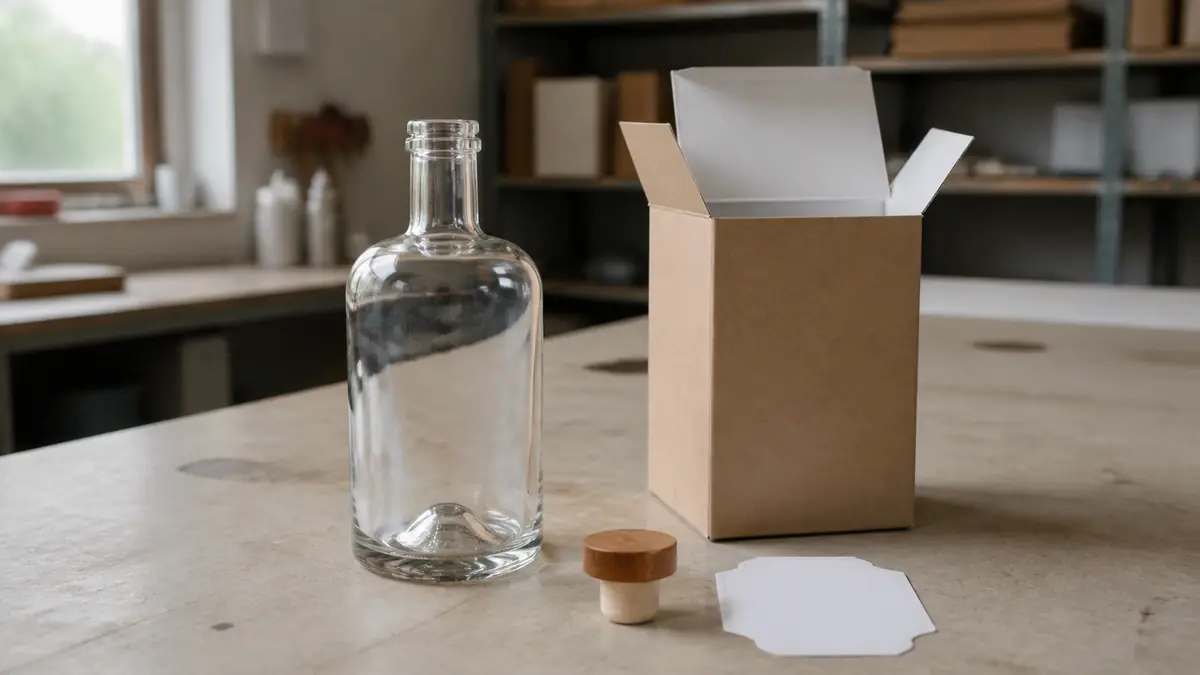
A liquor bottle without a label can be an acceptable empty sample or undecorated packaging component, but it should not be treated as a market-ready spirits pack. Once the bottle is filled and sealed for sale or distribution, the required information, placement, language, and approval route depend on the destination market, spirit category, and sales channel. A bottle with direct printing, etching, or other permanent decoration may carry label information without a paper sticker, so “no sticker” and “unlabeled” are not always the same condition.
Packaging buyers should approve the bottle, 装饰, legal copy, and filled pack as separate stages. This guide explains that handoff for commercial glass and ceramic liquor bottle projects. It uses current United States and European Union rules as examples, not as a universal legal checklist.
What can “a liquor bottle without a label” mean?
The first question is not whether a sticker is present. It is what is inside the bottle, what stage the project has reached, and what the bottle will be used for.
| Bottle status | Appropriate purpose | What it can confirm | What it cannot confirm |
|---|---|---|---|
| Empty blank sample | Early bottle selection and dimensional review | Shape, glass or ceramic appearance, nominal format, 处理, closure interface, carton fit, and available decoration area | Final artwork, legal copy, label adhesion, filled weight, or retail compliance |
| Undecorated production bottle | Delivery to an agreed decorator or contract filler | Approved bottle specification, 数量, packing configuration, and traceability documents defined by the project | That the finished alcoholic beverage may be released without market information |
| Decorated visual mockup | Brand, 颜色, 位置, and shelf-appearance review | General visual hierarchy and decoration concept | Regulatory approval or production performance when it uses illustrative copy or non-production materials |
| Compliance artwork proof | Review by the brand, importer, bottler, and qualified adviser or authority where required | Controlled copy, placement, language, version, and market-specific review status | Physical application quality unless produced on the real bottle with the intended process |
| Filled production pack | Sale or distribution after all required release checks | The combined bottle, 关闭, 装饰, information, coding, secondary packaging, and approved production record | Suitability for another country or product without a separate review |
An empty bottle can still have packaging, customs, food-contact, 运输, and commercial-document requirements. The important distinction is that the beverage-label rules for a sealed retail container should not be confused with the specification for an empty packaging component.
A label is more than a removable paper sticker
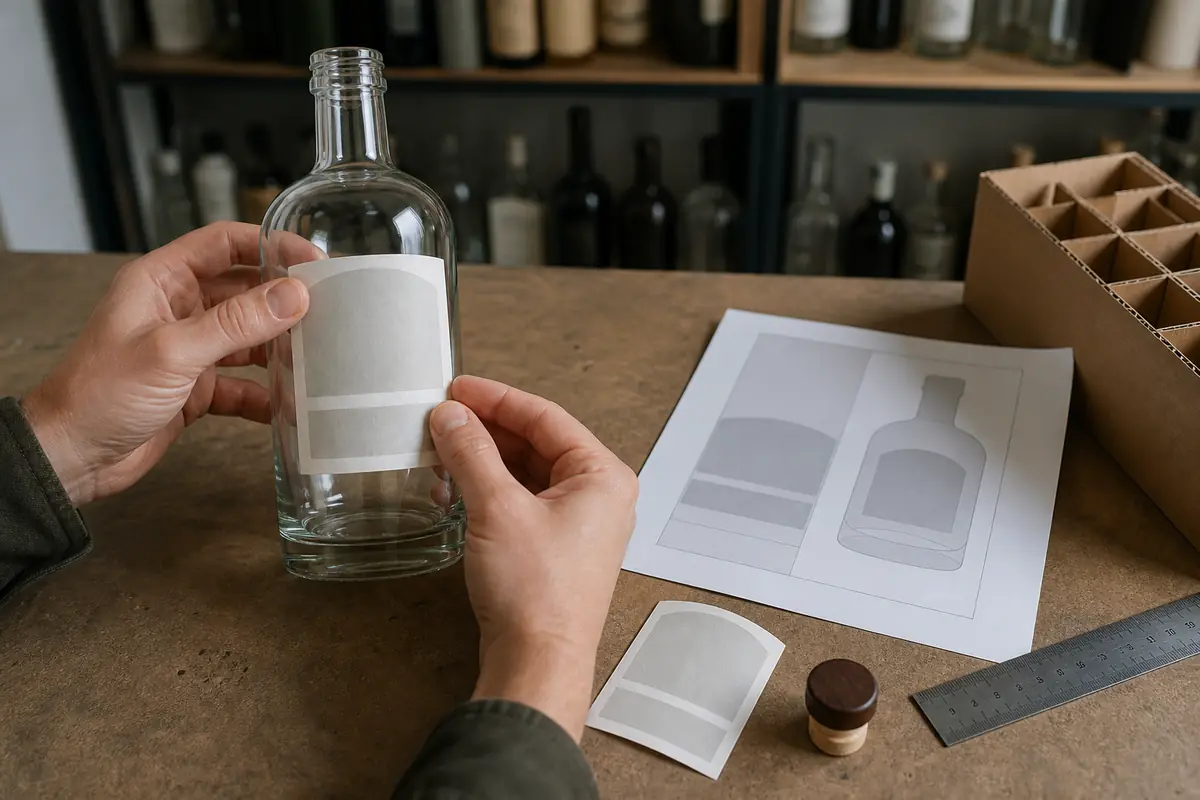
Packaging teams often use “label” to mean a pressure-sensitive paper or film piece. Regulations can use the term more broadly, and mandatory information may also be applied directly to the container when the relevant rules allow it.
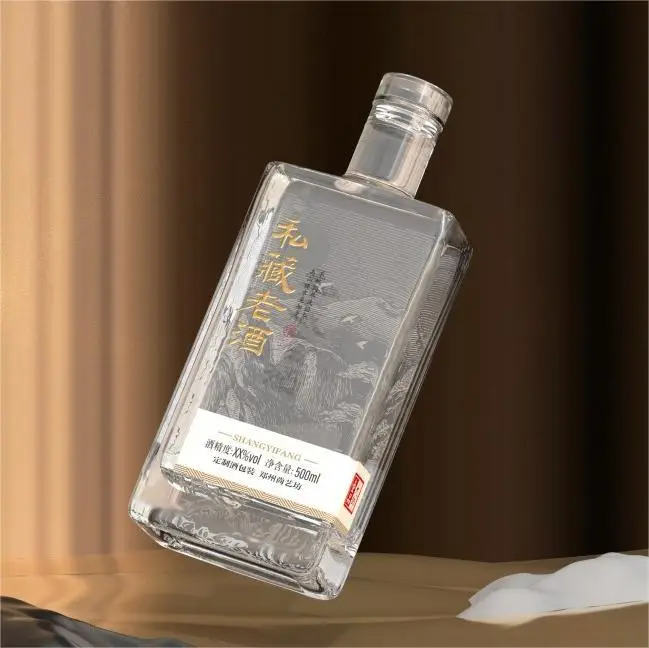
例如, the current U.S. federal 27 CFR部分 5 label standards explicitly address information that is etched, engraved, sandblasted, branded, stencilled, painted, printed, or otherwise applied to the bottle surface. They also require mandatory information to remain legible, visible, and appropriately contrasted. The color of both the container and the spirit matters when information is transparent or applied directly.
This means a clear bottle with white direct printing may face a different readability problem after it is filled with a pale or dark spirit. A decorated sample should therefore be reviewed both empty and under realistic filled-product viewing conditions. If a paper or film label is used, its die line, surface material, adhesive, application direction, and overlap limits belong in the packaging specification.
Shang Art’s comparison of screen printing, 烫金, and UV printing can help buyers separate direct decoration choices from pressure-sensitive labels. The final legal layout, 然而, remains a market-specific decision.
What a U.S. spirits project should confirm
The Alcohol and Tobacco Tax and Trade Bureau’s distilled spirits labeling hub states that distilled spirits must be properly labeled before sale in the U.S. marketplace. It separates mandatory information, optional statements, label approval, formulation, and other guidance rather than treating the front design as the entire label.
Information placement is not arbitrary
TTB’s mandatory information guidance says the brand name, alcohol content, and class, type, or other designation must appear in the same field of vision. Other required information may appear elsewhere, subject to the applicable rule. A narrow front panel, deeply curved shoulder, 压花, or large decorative image can therefore reduce the usable copy area even when the bottle looks spacious in a rendering.
Minimum type size can change with container size
As displayed in the eCFR on August 9, 2026, 27 CFR 5.53 requires mandatory information under Part 5 to be at least 2 millimeters high on containers over 200 milliliters and at least 1 millimeter high on containers of 200 milliliters or less. The federal health-warning rules use different capacity thresholds: 27 CFR部分 16 specifies 1 millimeter for containers of 237 milliliters or less, 2 millimeters for containers over 237 milliliters through 3 liters, 和 3 millimeters above 3 liters.
Those different thresholds are a practical reason to define the actual bottle capacity and complete copy deck before finalizing the label shape. They are not a complete U.S. checklist; product-specific disclosures, origin, state requirements, and other rules may also apply.
Artwork approval belongs before production printing
TTB’s current label approval overview explains when a Certificate of Label Approval (COLA) is required for products covered by the Federal Alcohol Administration Act and when a certificate of exemption may apply. The responsible industry member should determine the correct route before approving a production print run. A blank bottle sample, a brand presentation, and an approved label are three different deliverables.
What changes for an EU spirits project
The European Union uses a linked framework rather than a single generic “liquor label” rule. The consolidated Regulation (欧盟) 不 1169/2011 covers food information and operator responsibilities, while Regulation (欧盟) 2019/787 governs the definition, description, 推介会, and labelling of spirit drinks, including legal names and geographical indications.
The European Commission’s spirit drinks overview connects these legal bases and related guidance. A buyer should still confirm the exact product category, legal name, operator information, language, alcoholic strength, 数量, claims, geographical indication, and any national requirements with the responsible brand, importer, and qualified adviser. A layout accepted for the United States should not be copied unchanged into an EU project.
Separate legal approval from packaging performance
A compliant copy deck can still fail physically, while a beautiful and durable label can still carry incomplete or unapproved information. Treat these as two connected approval tracks.
| Decision | Primary owner | Evidence to retain |
|---|---|---|
| Destination market, spirit category, legal name, claims, and mandatory copy | Brand owner and importer, supported by qualified regulatory advice | Controlled market brief, reviewed artwork, approval or exemption record where applicable |
| 瓶子材质, capacity, dimensions, finish, and closure interface | Brand buyer, bottle supplier, and filler | Approved drawing, specification, physical sample, and closure data |
| Decoration method, print zone, 颜色, and label die line | Brand, bottle decorator, and label converter | Production artwork, color reference, decorated sample, and revision number |
| Label application and coding on the filling line | Bottler or contract filler | Line-trial record, 应用程序设置, code verification, and approved filled sample |
| Gift box, carton, and distribution visibility | Brand, packer, and logistics team | Complete packed sample and documented release checks |
The buyer should name one person who controls the artwork version. File names such as “final,” “final-new,” or “print-final-2” do not provide reliable revision control. Use a unique revision number, approval date, 目的地市场, product identity, and approver record on the controlled proof.
A five-gate path from blank bottle to released pack
- Approve the blank bottle. Confirm the material, drawing, capacity basis, 颈部饰面, closure interface, usable decoration area, 处理, and carton fit. Compare the relevant 玻璃瓶 或者 ceramic bottle route.
- Freeze the market brief. Record the destination, product category, channel, responsible importer or operator, language, intended claims, and approval route. For cross-border projects, use the responsibility questions in the custom liquor bottle importing checklist.
- Approve controlled artwork. Match legal copy with the actual printable area. Confirm which elements are a label, direct print, neck decoration, closure mark, lot code, or secondary-pack statement. Do not send unapproved draft copy to production.
- Test the real decorated pack. Use the intended bottle surface, label stock or ink system, 关闭, fill appearance, application method, 礼品盒, and shipping pack. Check legibility, alignment, adhesion, scuffing, code visibility, and whether secondary packaging obscures required information.
- Release one documented version. Retain the approved bottle specification, artwork revision, market review, physical sample, 应用程序设置, and production acceptance criteria. Any later change should be assessed for both regulatory and packaging effects.
What to send with a bottle and label enquiry
A useful first brief includes:
- destination country or countries and planned sales channel;
- spirit category, intended capacity, and whether the project is an empty sample or filled-product launch;
- preferred glass or ceramic bottle, closure type, and any dimensional limits from the filling line;
- paper or film label, screen printing, 紫外线印刷, 烫金, coating, 糖霜, 压花, or a combined decoration route;
- current artwork status and the party responsible for legal review;
- 礼品盒, carton, coding, and handling requirements;
- quantity and requested project timing, to be confirmed against the selected bottle and process.
The custom bottle quote checklist and Shang Art’s bottle customization workflow can help organize those inputs. Shang Art can review bottle material, available decoration area, closure coordination, sample direction, and packaging options. Final market compliance and label approval remain the responsibility of the brand, importer, bottler, and their qualified advisers.
To compare an undecorated bottle sample with a label-ready or directly decorated version, send Shang Art your project brief with the destination market, 瓶型, 关闭, decoration plan, and artwork status.